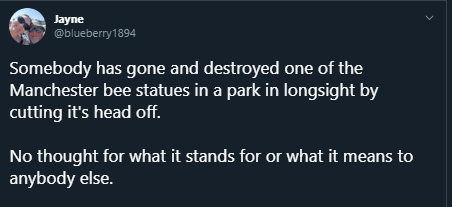
Early in the morning of Sunday the 12th April, a local resident reported the vandalisation of Longsight’s famous Bee Unique sculpture.
The Sculpture (as seen above) was sawed off by a currently unknown vandal and has now been covered by a temporary black bag before reconstruction can begin.
This came as a surprise to many in early April, especially given Longsight had seen one of its lowest levels of crime just one month prior – with March 2020 seeing just three reported cases of street crime compared to 117 incidents reported in the same month the previous year.
The Bee Unique sculpture is symbolic of Longsight as a whole. Designed by graffiti artist Russel Meeham – who goes by the name Quebek.
The statue was based on drawings given to him by students from Stanley Grove Primary Academy.
Combined with his own creative outlook, the bee design was conceived and can be considered an amalgamation of everything that makes Longsight unique, with the vibrant array of colours representing the many different cultures and communities living side by side.
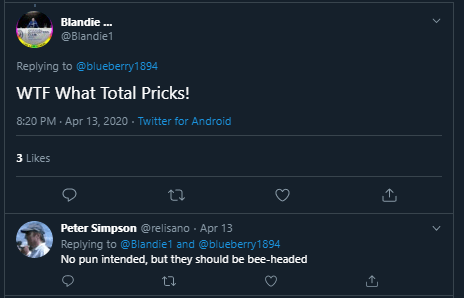
The cultural importance of the Bee is a source of pride for the people of Longsight and this act of vandalism has sparked outrage across social media, with angry citizens taking to Twitter to vent their frustration
Yet the spirit of the Bee lives on, and while this incident will undoubtedly be a topic of content for the months to come, has proven the strong sense of community that holds the people of Longsight together.
With COVID-19 forcing businesses, workers, students and the self-employed into lockdown, the economy has come to a grinding halt.
Lockdown measures have already exceeded the timeframe they expected to endure, the forecasted return to normality is now set for late September to early October.
With many businesses forced to close, some – particularly in the catering industry – have been able to operate through door to door delivery. Yet these businesses have not gone unscathed.
I spoke to Mr Asif Rajah, the owner of two-time finalist of the British Curry Awards and two-time winner of the TripAdvisor Excellence Award, Mazza Kebab house, located at 604 Stockport Rd
When questioned on the issues affecting firms trying to survive the hazardous landscape created by COVID-19, Mr Rajah stated: “The food retail business relies on a number of key elements to be profitable. A strong, reliable and cost-effective supply chain, talented, hardworking employees and a loyal customer base. We have seen an effect in all three of these areas.”
Like a significant proportion of UK businesses being negatively impacted by the current crisis, Mazza is an small to medium sized enterprise (SME), which means it does not have sufficient collateral to survive the current economic shutdown without problems.
According to Parliament statistics, in 2019, SMEs accounted for 99% of all UK businesses. Yet while SMEs like Mazza form the backbone of the UK economy, the vast majority of them don’t make it past 10 years, showing just how detrimental a small change in profitability can be.
To support these businesses – and to prevent economic issues from spiralling out of control – the government has offered to pay for 80% of companies’ staff wages. According to HMRC, over 435,000 firms have applied for the government Furlough scheme, with Mazza itself counted within that number.
Mr Rajah commented: “As soon as the Furlough Scheme was introduced, pressure to pay staff wages while income slowed was certainly alleviated, but our rent still needed to be paid. We received a business rates holiday which was helpful, as well as a grant to cover the loss of income, but this has by no means matched our usual takings.”
After briefly closing, Mazza decided to reopen on a delivery and collection only basis – a last resort for Mr Rajah, who informed me: “At Mazza, 82% of our customers chose to eat inside. With this not being an option, we decided we had to bring a delivery service onboard.”
Through the current crisis, many businesses are learning a lot about their key areas of profitability – most importantly, their customers. Indeed, many smaller firms rely on a select group of loyal customers who regularly use their services over any other in order to stay afloat.
This is because they do not have the wide scale reputability of multi-national corporations (MNCs) like McDonald’s, who serve over 3.8 million unique customers every day.
Most customers loyal to smaller firms are believed to be community locals who don’t want to travel too far out of their way for a particular service. Yet upon opening up delivery options for their customers, Mazza found out that this is not always the case.
Mr Rajah told me: “What has been interesting is customers we would see regularly in-store were actually ordering deliveries from significant distances. We are now seeing how far they were travelling for our food. We have been delivering to Bury, Eccles, Hale – all areas at least 6-10 miles away from our location.”
While many small business owners in Longsight have seen their revenues negatively affected by the current crisis, they can still take positives from this unprecedented situation, taking the opportunity to develop their businesses into more rounded, consumer-friendly entities.
Mr Rajah agrees with this sentiment: “Overall, COVID-19 has affected our business with regards to eat-in and will continue to do so throughout the social distancing period. The delivery service was started out of necessity, but we will keep it in place moving forward to help service our community and reduce the amount individuals have to travel.”
This time of year is very special for people of Muslim heritage. Marked by fasting, prayer, and most importantly, community, Ramadan is the most important month in the Muslim calendar.
This year, however, will be markedly different for the people of Longsight. In the midst of a global pandemic which has seen non-essential businesses forced to close and an enforced lockdown preventing people from spending time with family and friends, religious institutions have had no option but to close their doors to the public.
28.3% of households in the Ardwick and Longsight area owned by people of Asian descent and with Longsight’s main Mosque, the Makki Masjid, now closed, the community’s local Muslims have been left without a place to worship during such a holy time.
Makki Masjid – 125 Beresford Road, Longsight
One such Muslim living in Longsight, who wishes to remain anonymous, spoke to me about the issues that this outbreak is causing for him and his family. “It’s very hard for me and my family. Usually, we would meet up and exchange gifts with each other at my grandparent’s household, however due to health concerns I won’t be able to see any of my relatives during Eid Mubarak. It’s a big family tradition of ours that we’ve not lost.”
When speaking about how his family are coping with isolation, the resident told me: “We usually pray together at least once a week around this time of year. We have managed to stay in touch with family online, but given the current situation no one from our close or extended family have been able to meet up
Due to the mass percentage of Muslim people that take up the population of Longsight there are a lot of people who will struggle to worship without a Mosque during such a holy time for them.
the Mosques Manager Faheem Ali is well aware of this issue and announced that The Makki Masjid will be combating this problem by offering weekly online classes for people to attend via platforms such as zoom.
When speaking about how his family are coping with isolation this person told me: “We usually pray together every year around this time of year at least once a week.This year however we have spoken with family online, but given the current situation no members of our family or extended family have met up outside our own households.”
This unnamed contributor added: “Being unable to participate in the congregational night prayer this month has been tough to deal with – it’s a very special time for all Muslims. But I understand that the closure of the mosques is only for our own safety and I 100% agree with the measures that have been taken.”
The Mosque’s Manager, Faheem Ali, is well aware of the issues lockdown is presenting for local worshippers and announced that the Makki Masjid would seek to combat this problem by offering weekly online classes for people to attend via platforms such as Zoom. Since, many people have been using the online classes to pray together with fellow members of the Muslim community.